arXiv preprint

RePos: Relative-to-Absolute Output Factorization for Cross-Environment WiFi-Based 3D Human Pose Estimation

Zhangcheng Hou1 Tomoaki Ohtsuki1
1Keio University, Yokohama, Japan
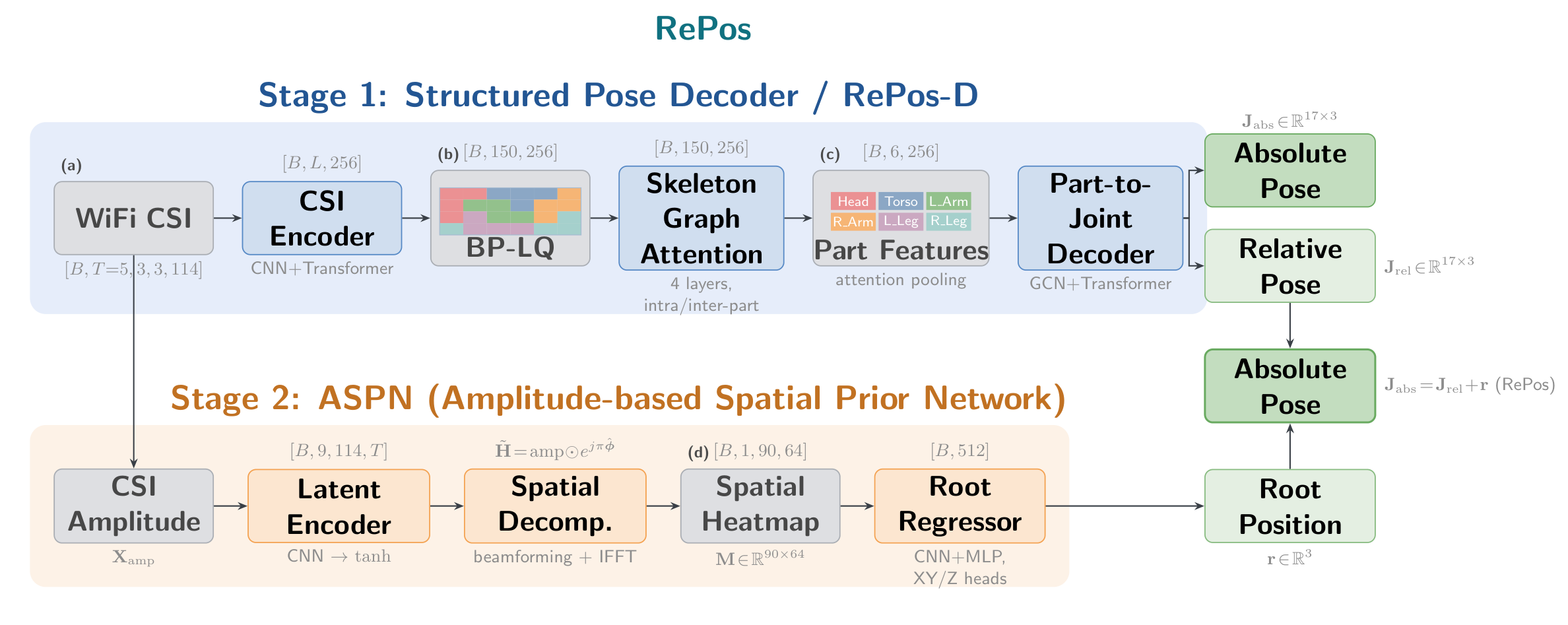
RePos architecture: a structured pose decoder predicts the root-relative pose while a separate amplitude-based branch predicts the root position; the two combine into the absolute pose.

RePos overview. Stage 1 (Structured Pose Decoder). WiFi CSI is encoded and grouped into body-part latent queries (BP-LQ), refined by Skeleton Graph Attention (SGA) along the kinematic tree, and decoded into a room-agnostic relative pose. Stage 2 (ASPN). A separate Amplitude-based Spatial Prior Network turns CSI amplitude into a spatial heatmap through a differentiable spatial-decomposition module and regresses the root position. Relative pose and root combine into the absolute pose; a single-stage variant, RePos-D, regresses the absolute pose directly for in-domain deployment.

Abstract

Device-free 3D human pose estimation using commodity WiFi Channel State Information (CSI) enables privacy-preserving and illumination-robust human sensing, but its deployment is limited by poor cross-environment generalization. Unlike images, CSI measurements do not have a spatially localized correspondence to body parts and are heavily affected by multipath propagation, causing models that regress absolute poses to entangle body structure with environment-specific location cues.

Within a single environment this coupling is benign: an end-to-end absolute-pose variant, RePos-D, already achieves state-of-the-art accuracy on Person-in-WiFi-3D (86.9 mm MPJPE, a 3.4% gain over the previous best WiFi method). Across environments, however, the same model overfits position and degrades sharply. We therefore propose RePos, a factorized framework that separates root-relative pose estimation from root localization. By preventing absolute-pose supervision from affecting the structure branch, RePos keeps its pose representation environment-stable: CSI features are grouped into body-part latent queries that skeleton-guided modeling refines into the pose, while a separate amplitude-based network estimates the root position through a differentiable spatial-decomposition module.

Under the strict MM-Fi cross-environment protocol, RePos achieves MPJPEs of 254.4–296.1 mm, a 10–21% reduction over existing WiFi-based methods. The improvement is consistent across activity protocols, leave-one-environment-out splits, and leakage-free few-shot transfer. Analysis of the learned features shows that relative-pose representations remain largely position-agnostic, while root localization retains environment dependence: structure transfers across rooms, absolute placement does not.
Key ideas

1. Output factorization

RePos predicts a root-relative pose and a root position through separate branches, so absolute-position supervision never reaches the structure branch. This avoids coordinate overfitting — entangling body configuration with the training room's position cues — and lets the structural representation transfer to unseen environments.

2. Structured Pose Decoder

CSI features are compressed into 150 body-part latent queries (BP-LQ) and refined by Skeleton Graph Attention (SGA), which passes messages along the kinematic tree. The result is a compact, anatomically organized representation that decodes into a room-agnostic relative pose.

3. ASPN localization

A separate Amplitude-based Spatial Prior Network estimates the root position from CSI amplitude through a differentiable spatial-decomposition module — calibration-free and without relying on noisy commodity phase — and is the part that a few target frames can recalibrate for a new room.

Cross-environment results on MM-Fi

Method MPJPE (mm) ↓ PA-MPJPE (mm) ↓
MetaFi++ (IoT-J'23)347.5121.5
HPE-Li (ECCV'24)361.1105.6
DT-Pose (EIS'26)330.4105.4
GraphPose-Fi (ICASSP'26)355.8109.6
RePos (ours) 296.1 102.0

MM-Fi Setting-3 cross-environment (train E01–E03, test on the unseen room E04), Protocol 3 (all 27 activities). Across the three activity protocols RePos lowers MPJPE by 10–21% over the strongest baseline.

In-domain results on Person-in-WiFi-3D

Method MPJPE (mm) ↓ PA-MPJPE (mm) ↓
MetaFi++ (IoT-J'23)132.075.8
HPE-Li (ECCV'24)120.269.5
Person-in-WiFi-3D (CVPR'24)91.7
DT-Pose (EIS'26)90.058.7
RePos-D (ours) 86.9 57.5

Person-in-WiFi-3D, in-domain (training and testing in the same environment). The direct variant RePos-D is state of the art — 86.9 mm MPJPE, a 3.4% gain over the best prior WiFi method (DT-Pose) and 5.2% over the dataset's native baseline. Within a fixed room, regressing absolute coordinates directly is already effective; the factorized RePos targets the cross-environment regime above.

Qualitative comparisons

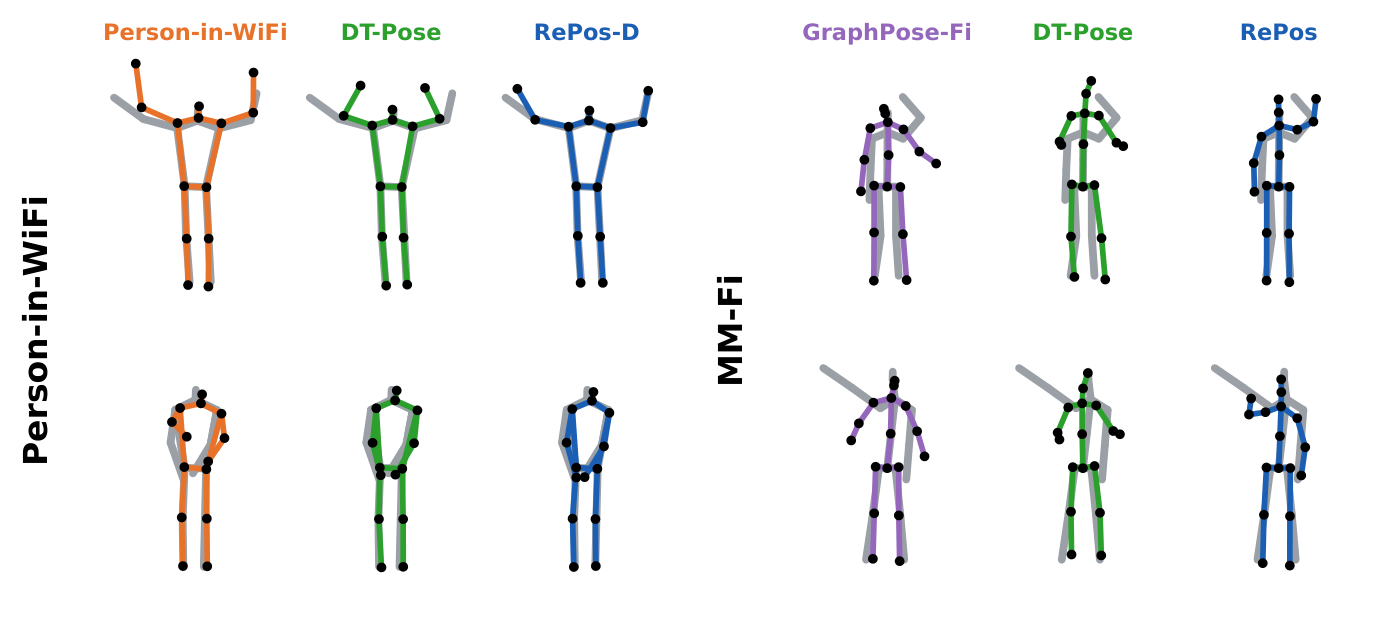
Qualitative pose comparison against WiFi baselines on Person-in-WiFi-3D and MM-Fi, with each prediction overlaid on the ground truth.

Each method's prediction (color) is overlaid on the root-centered ground truth (gray). In-domain on Person-in-WiFi-3D (left), RePos-D is the most faithful; under the harder cross-environment MM-Fi setting (right), RePos still tracks the overall pose while the baselines deviate more in the limbs.

Citation

@article{hou2026repos,
  title   = {RePos: Relative-to-Absolute Output Factorization for
             Cross-Environment WiFi-Based 3D Human Pose Estimation},
  author  = {Hou, Zhangcheng and Ohtsuki, Tomoaki},
  journal = {arXiv preprint arXiv:2607.02986},
  year    = {2026}
}